

Kiernan Baxter-Kauf reflects on her debate experience, in her own words
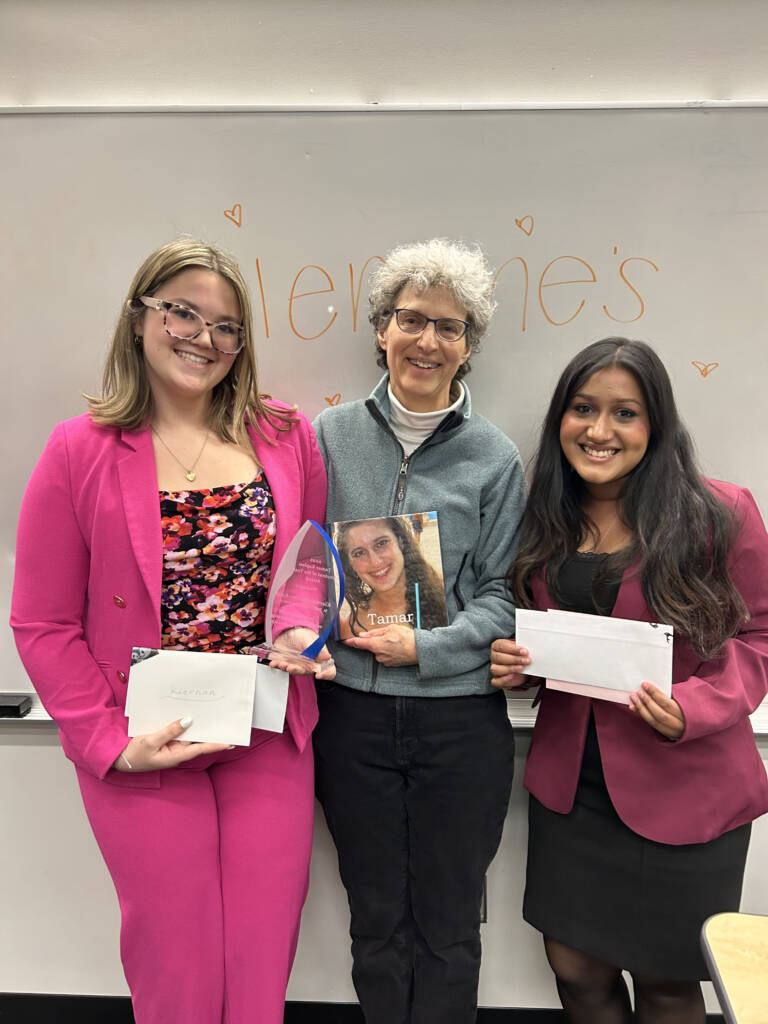
Kiernan (left) stands with the award runner-up, Raina Nehreen (right) and Tamar Kaplan’s family.
At the 2026 MSHSL State Debate Tournament, the Kaplan family presented the annual Tamar Kaplan Student of the Year Award in honor of the life and person qualities of Tamar Kaplan, MNUDL debate alum. Learn more about the award and past winners/finalists here, and why we celebrate her at this blog article.
This year’s winner, Kiernan Baxter Kauf – also nominated for the NAUDL Debater of the Year Award! – embodies the spirit Tamar represented: exceptional achievement paired with unwavering commitment to service. Her journey was a powerful metamorphosis from a sixth-grader who mastered “invisibility” in middle school hallways to a passionate mentor who has spent three years coaching at her former middle school. She channels the same patient guidance she benefited from into the next generation of debaters.
Learn more about Kiernan’s debate experience, in her own words, and the qualities that earned her the nomination below.
From Observer to Advocate: My Journey in Speech and Debate
By: Kiernan Baxter Kauf
The 6th-grade version of myself was a master of invisibility. In the crowded hallways of middle school, I was the quiet observer, governed by a paralyzing fear of being noticed, let alone heard. My thoughts were a chaotic internal monologue that I lacked the courage to externalize. However, that changed the moment I stepped into the humid, paper-strewn room of my first debate practice. I didn’t know then that I was entering a sanctuary that would dismantle my anxieties and replace them with a lifelong sense of purpose.
In earlier days, debate provided a supportive community far larger and more diverse than any I had ever known. As an “awkward” child, the structure of a formal argument offered a safety net. In a debate round, there are rules for when you speak and when you listen. This structure gave me the “permission” I needed to express myself.
Crucially, the activity demystified the world of public policy. I used to believe that engaging with complex global issues was reserved for those with “insider connections” or elite backgrounds. Debate taught me otherwise. I learned that the most powerful tool in the room wasn’t a fancy title or a pedigree; it was the ability to synthesize an argument and ask the right questions. I discovered that information was a public utility, and with the right research skills, I could build a case as persuasive as any “expert.” This realization—that intellectual authority is earned through preparation rather than status—was my first real lesson in equity.
My commitment to the activity won’t end with my graduation; in many ways, it is just the prologue. I felt a magnetic pull back to the program. I realized I didn’t just want to be a successful debater; I wanted to be the guide I had so desperately needed when I was twelve years old. I reached out to my former coach, and for the past three years, I have served as a mentor for the next generation of students at my old middle school.
Stepping into the role of a coach for middle schoolers shifted my perspective entirely. I quickly realized that teaching debate is only 20% about “counterplans” or “impact turns.” The other 80% is rooted in social-emotional learning.
My students today mirror the same quiet fears I once held. I see it in the way a student’s hands shake as they hold their flow sheet, or the way they look at the floor when a cross-examination gets intense. My role is to walk with them through that discomfort. I focus on helping them manage the visceral stress of public performance and, more importantly, teaching them how to engage respectfully with disagreement. In an increasingly polarized world, teaching a thirteen-year-old that they can disagree with someone’s ideas while still respecting their humanity is perhaps the most radical and necessary skill I can provide.
Teaching has been my most profound lesson in leadership. It has stripped away the ego of “winning” and replaced it with the fulfillment of “investing.” I have learned that every student, regardless of their natural talent or background, is looking for a consistent presence—someone who believes in their potential even when they are staring at a blank page in frustration.
I remember a specific student who refused to speak for the first three weeks of practice. We sat together and worked not on winning a trophy, but on finding one single “why” for the topic we were discussing. By the end of the semester, that student wasn’t just speaking; they were leading a rebuttal with a clarity that brought tears to my eyes. In that moment, I realized that leadership isn’t about being the loudest person in the room; it’s about creating a space where others feel safe enough to find their own volume.
Today, I am no longer that quiet observer. Debate transformed me into an active participant in my own life and the lives of my students. This journey has cemented my sense of purpose: I want to be a lifelong advocate for mentorship and education. I have seen firsthand how a single supportive environment can turn an “awkward” child into a confident leader. As I look toward the future, I carry with me the firm belief that when we give young people the tools to speak up, we aren’t just teaching them how to win an argument—we are teaching them how to change their world.

